

ISOs vs NSOs: What Are They and Why Should You Care?
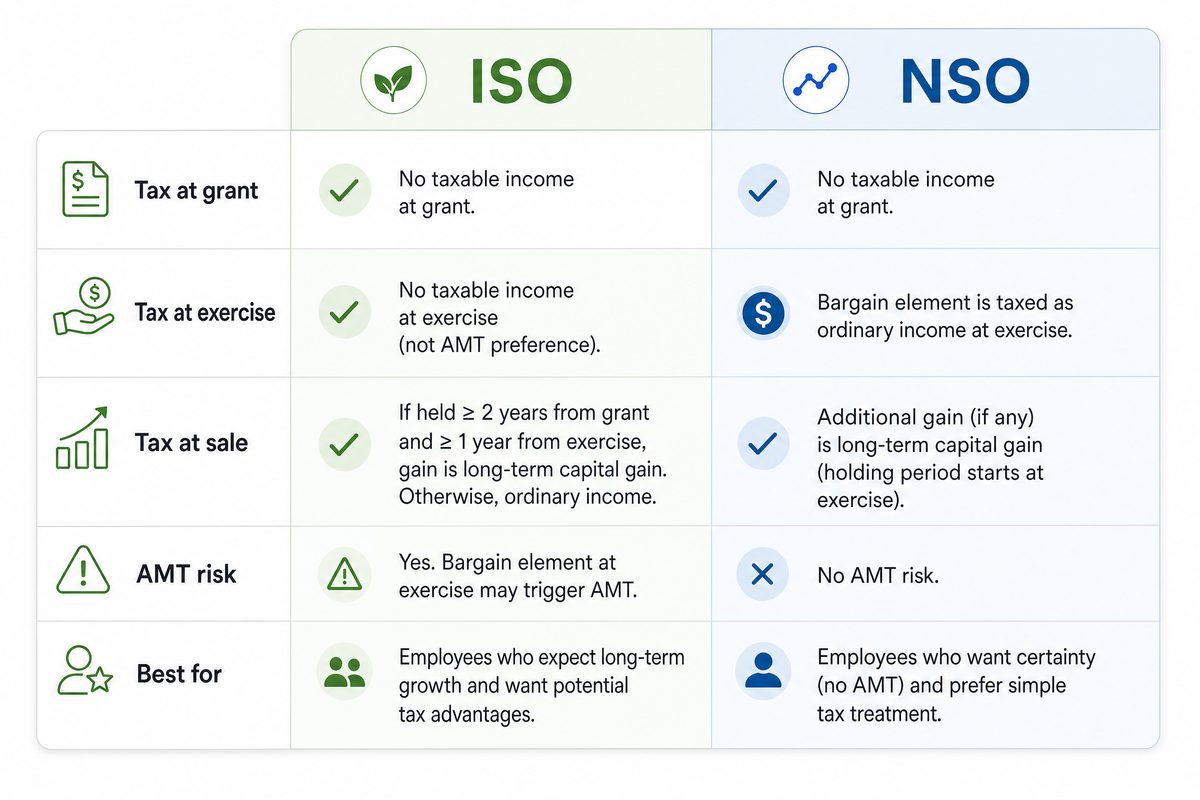
First things first: your company’s stock options come in two main flavors — Incentive Stock Options (ISOs) and Non-Qualified Stock Options (NSOs). Both give you the right to buy company shares at a set price (the strike price), but their tax treatments are quite different, which can make a huge financial difference.
- Incentive Stock Options (ISOs) are usually offered to employees (not consultants or advisors) and come with special tax advantages — if you play by the IRS rules.
- Non-Qualified Stock Options (NSOs) are more common for contractors, advisors, or sometimes employees. They don’t get the same tax breaks.
Key tax difference: When you exercise NSOs (buy your shares), you owe ordinary income tax on the difference between the strike price and the current fair market value (FMV) of the stock — even if you hold the shares afterward. With ISOs, you usually don’t owe taxes at exercise — but there's a catch: the exercise difference counts for the Alternative Minimum Tax (AMT). More on that soon.
The Exercise Decision: When and How to Buy Your Shares
Exercising means using your options to buy actual shares at the strike price. The big question: when to exercise?
- Wait and see: You can wait until you sell your shares to exercise. This delays taxes but risks paying a higher price later or losing options if your employment ends.
- Early exercise: You exercise your options before they fully vest or before your company has a big valuation. This can save taxes if you pay a low strike price on shares that are worth very little or nothing yet.
The cash flow problem: Exercising requires cash upfront — you must pay the strike price for each share you buy. Plus, taxes might hit you sooner than you expect. For startups, this can be a wallet buster.
The AMT Surprise: Why ISOs Can Lead to a Tax Bill Before You Sell
Here’s the part that trips up so many employees: the Alternative Minimum Tax (AMT). It’s a parallel tax system designed to ensure that you pay at least some tax if you have certain “preferences,” like exercising ISOs.
With ISOs, the difference between the FMV of the shares at exercise and your strike price — the so-called "bargain element" — is added to your income for AMT purposes, even if you don’t sell the shares. This can trigger a large tax bill.
Example:
- Salary: $100,000
- Options: 10,000 ISOs with strike price $1
- FMV at exercise: $10 per share
The bargain element is ($10 - $1) × 10,000 = $90,000.
This $90,000 is added to your income for AMT calculations, so instead of $100K, your AMT income is $190K. That could mean thousands of dollars in AMT tax — even though you haven’t sold any shares or made actual cash.
Warning: Exercising your ISOs without planning for AMT is the #1 tax mistake startup employees make. It can lead to a tax bill you didn’t budget for, forcing you to scramble for cash.
The 83(b) Election: Your Early-Stage Tax Secret Weapon
If you have the option to early exercise unvested shares, the 83(b) election lets you tell the IRS to tax you on their value at exercise — even though you haven’t vested them yet.
Why does this matter? Because if you file the 83(b) election within 30 days of exercising, you lock in a low taxable amount now (often near zero if the company is very early-stage). Then, future gains can be taxed at the lower long-term capital gains rate when you sell.
But be warned:
- You must file the 83(b) election within 30 days of exercise — no exceptions.
- If you leave the company before your shares vest, you lose the unvested shares but you don’t get a refund on the taxes you already paid.
The 83(b) election can be a huge saver for early employees who expect their company’s value to grow a lot over time.
Sale Scenarios: When Do You Pay Taxes and at What Rate?
Taxes on stock options don’t end when you exercise; they finish when you sell your shares. The tax rate depends on how long you hold the shares after exercising and on the type of options you have.
- Short-term capital gains: If you sell shares within one year of exercise, gains are taxed at your ordinary income tax rate. Ouch.
- Long-term capital gains: Hold for more than one year after exercising (and at least two years after the original grant date for ISOs) and pay a lower tax rate — often 15% or 20% instead of 35%+
Qualifying vs disqualifying dispositions: For ISOs, selling shares after meeting these holding periods is a qualifying disposition and taxed favorably. Selling earlier triggers a disqualifying disposition, with some or all gains taxed as ordinary income.
Decision Tree: Should You Early Exercise?
Here’s a quick guide to help decide if early exercise is right for you:
- Is your strike price very low? (close to zero or pennies) → Early exercise can lock in low AMT and capital gains basis
- Is the company very early-stage? (little to no current FMV) → Early exercise + 83(b) election can save big future taxes
- Do you have cash to pay strike price AND potential AMT tax? If no → early exercise may not be viable
- Are you confident you’ll stay long enough to vest and hold for capital gains? If no → early exercise is riskier
If you answered “yes” to most, early exercise is worth strong consideration. If not, waiting to exercise may be better — just watch out for expiration dates on your options.
A Complete Walkthrough: From Grant to Sale
Let’s follow Jane, a startup employee granted 10,000 ISOs with a $1 strike price when the company is pre-revenue and valued very low.
- Grant: Jane receives her options.
- Early Exercise: She exercises all options immediately and files an 83(b) election within 30 days. Since the company is valued near zero, she pays $10,000 (10,000 × $1) to buy shares and minimal taxes on exercise.
- Vesting: Jane stays for 4 years and fully vests.
- Growth: The company grows, and after 3 years, the shares are worth $50 each.
- Sale: Jane sells all her shares. Because she held for over 1 year after exercise and more than 2 years after the grant date, her gains qualify for long-term capital gains tax. The gain is (50 - 1) × 10,000 = $490,000.
- Taxes: She pays lower capital gains tax rates on $490,000 instead of ordinary income tax on $490,000 + AMT surprise.
This scenario shows why early exercise + 83(b) can be a powerful tax saver, but it requires cash upfront and a willingness to bet on the company's future.
Final Thoughts and Your Best Next Steps
Look, the startup stock option tax system is confusing and opaque — it sometimes feels like it was designed to trip you up. Your options might seem like “free money,” but exercising them can trigger unexpected tax bills that hurt your wallet.
Remember: The #1 mistake is exercising ISOs without planning for the AMT. Always run the numbers and know your cash needs before making moves.
While this guide gives you the vocabulary and framework to understand your options, please consult a tax professional who knows startup equity to avoid costly surprises.
Got stock options? Ready to find your next startup gig where you can build wealth and learn more about this stuff? Check out NewJob.tech — your go-to place for startup jobs and career advice.