
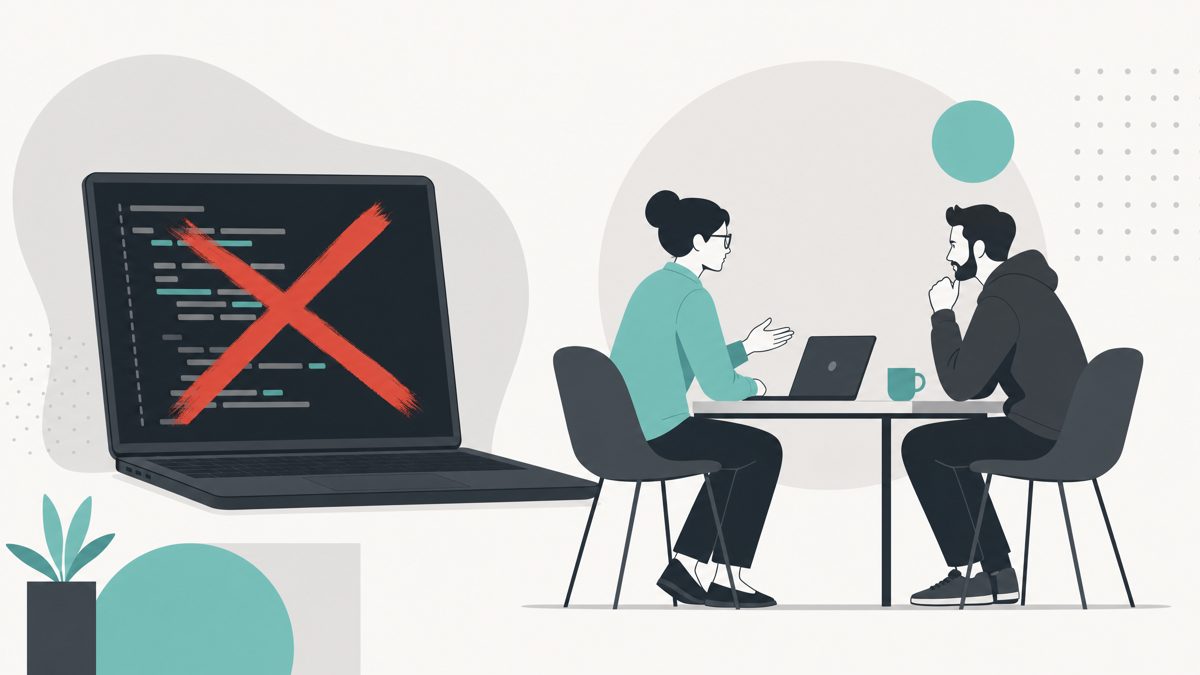
The culprit? Advanced AI code generation.
Why the Take-Home Failed
When LLMs became capable of scaffolding entire web applications, writing complex SQL queries, and generating comprehensive test suites in seconds, the signal-to-noise ratio of a take-home assignment dropped to zero.
Startups realized they were no longer evaluating a candidate's ability to build software; they were evaluating the candidate's ability to prompt an AI. While AI-assisted coding is a crucial skill (especially for the rising AI Engineer role), a take-home project couldn't verify if the candidate actually understood the architecture they submitted.
What Startups Are Doing Instead
Based on our analysis of hiring processes across 50+ top startups, companies have pivoted to three new evaluation methods:
1. The "Pair Programming with AI" Session
Instead of banning AI, startups embrace it. Candidates are given a complex, messy codebase and asked to add a feature or fix a bug while sharing their screen. They are encouraged to use Copilot, ChatGPT, or whatever tools they prefer. The interviewer evaluates how the candidate navigates the codebase, formulates prompts, and—crucially—how they debug when the AI inevitably hallucinates.
2. System Architecture Deep Dives
Because writing boilerplate code is now trivial, the value of an engineer has shifted entirely to system design and architecture. Interviews now focus heavily on scaling, data modeling, and trade-off discussions. You can't easily prompt your way through a live debate about why you chose Postgres over DynamoDB for a specific access pattern.
3. The "Code Review" Interview
Candidates are given a Pull Request containing a mix of human and AI-generated code with subtle bugs, security flaws, and performance bottlenecks. The candidate must review the code, leave comments, and explain their reasoning. This tests reading comprehension and domain expertise—skills that are much harder to fake.
How to Prepare
If you're interviewing for an engineering role in 2026, stop grinding LeetCode and stop spending weekends on take-home projects. Instead, practice reading large open-source codebases, get comfortable explaining your architectural decisions out loud, and master the art of debugging AI-generated code.