

The psychology: survivor guilt is real and science-backed
Survivor guilt isn't just a dramatic phrase for awkward watercooler conversations — it's a studied psychological response. Research from places like the Harvard Business Review and clinical journals shows retained employees commonly experience guilt, anxiety, and decreased engagement after layoffs.
You're likely to feel awful because you saw teammates lose livelihoods and you didn't. That's rational. You were part of the same team, same projects, same late nights. Feeling terrible doesn't mean you're weak; it means you're human.
It felt wrong to open my laptop and pretend everything was normal while Sam, who owned the data pipeline, was texted about severance three blocks away. I kept thinking: did I miss signs? Did I do something wrong?
Expect grief, anger, hypervigilance, and a productivity dip — and know this is common. In fact, 74% of retained employees report decreased productivity after layoffs (Harvard Business Review). Don't punish yourself for a natural reaction.
The first 48 hours: practical triage
The hours after the cuts are triage. You need to do emotional processing, yes, but also set up facts and protections. Here's a short checklist that will calm your future self.
- Document your new scope: write a one-page list of what you're doing now versus last week. Include specific projects, owners (names), and deadlines. Timestamp it and save it to your work drive and a personal cloud.
- Check equity vesting and cliffs: log into Carta/Shareworks immediately. Note your vesting schedule, any accelerated vesting clauses, and whether your stock options are now market-exercisable. If you don't see answers, email HR: "Please confirm my current equity schedule and any recent changes."
- Update your resume quietly: open a private doc and add recent accomplishments and systems you owned. Keep this offline or in a private Google Drive folder labelled "career." Don't blast LinkedIn yet.
- Capture institutional knowledge: export spreadsheets, ticket queues, runbooks, and Slack threads you own or rely on. If you were the only person who knew how to deploy service X, document step-by-step instructions now.
- Check benefits and severance for others: read the layoff announcement and HR emails carefully. They often contain clauses about rehiring, severance timelines, and outplacement resources you can share with colleagues.
The "Stay or Go" framework — how to decide
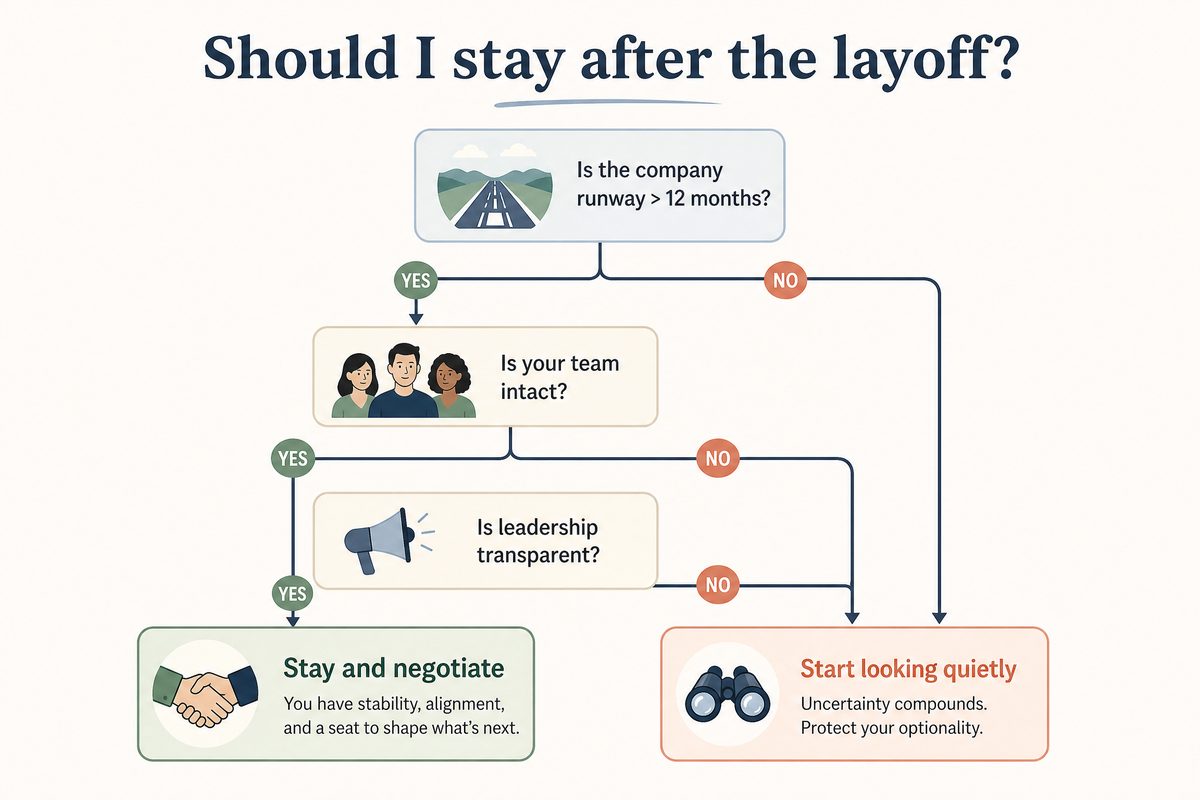
Staying or leaving after a layoff is not a moral decision — it's a practical one. I use a four-criteria framework with specific thresholds. Score each from 0–5 and add them up. If you score 14 or more, staying is reasonable. Under 10? Start moving.
- Runway (how much funding/time the company has): runway >12 months = 5, 6–12 months = 3, <6 months = 1. If the company has less than 9 months and no clear revenue path, treat that as a red flag.
- Team composition and redundancy: do the remaining folks cover critical roles or did you lose unique owners? If 1–2 people have to wear five hats, score lower. If critical roles are intact and hiring plans exist, score higher.
- Leadership response and transparency: are executives communicating a realistic plan every week, or are you hearing radio silence and phrase-heavy town halls? Weekly, honest roadmaps = 5. Vague PR talk = 1.
- Your role change and satisfaction: did your responsibilities become meaningful and visible, or did you get dumped with grunt work? If you're now leading product work with decision power = 5. If you're doing admin cleanup without agency = 1.
Score it. Then run a sanity check: if your mental health score is low (you dread Mondays, you can't sleep), don't ignore it even if math says stay. Numbers matter, but so do boundaries.
Negotiating from a position of strength
Yes, you have leverage now. You cannot wave it like a club, but you can be direct. The company just trimmed payroll and is trying to retain knowledge — that's bargaining power for survivors.
Don't ask for "if possible" raises. Make specific asks tied to business value and risk mitigation: more equity, title adjustment, protected headcount for your team, or a retention bonus. Be reasonable: ask for what covers the next 12–18 months of your personal runway.
- Know your numbers: compute the dollar value of lost colleagues' work if you were the only person who can do X. Use that as leverage in conversations.
- Time your ask: schedule one-on-one with your manager within 7 days. Use your documented new scope as evidence.
- Be prepared to walk: have a quiet job search on the side (see below) so your requests aren't empty threats.
Script: talking to your manager about scope and compensation
Use this script verbatim if you're not sure how to start. It's assertive without being dramatic.
"Thanks for meeting. In the last week my responsibilities changed: I'm now covering A, B, and C (I documented this here — I'll share). I want to be clear about expectations and support. Given the increased scope and the retention risk to the company if this knowledge is lost, I'd like to discuss a title adjustment to Senior/Lead for the new duties, a 20% increase to my base or a one-time retention bonus of $15,000, and a vesting acceleration conversation with HR for my options. If we can agree on a concrete plan and timeline for these items, I'm committed to leading this work. If not, I need to evaluate other options for my career."
Tweak numbers: if you make $120k, 20% or $24k is reasonable; if you're in the $200k+ band, use title and equity language. Always ask for timeline and written confirmation.
The quiet job search: how to look without burning bridges
You'll want options. Do this stealthily and professionally so the company doesn't see you as disloyal. Here's a realistic playbook I used twice in five years.
- LinkedIn privacy: change "Share profile updates" to off. Update your headline to something neutral like "Engineering Manager — Platform" not "Open to work."
- Resume and references: keep your resume up-to-date offline. Politely ask a former manager or peer to be a reference, and tell them it might be checked discreetly.
- Recruiters and networking: set expectations with recruiters — "I'm currently employed and exploring quietly." Use non-work email for job-related communication and schedule calls outside work hours.
- Interview scheduling: block calendar time labeled "Personal" or "Doctor" if you don't want to advertise interviews. Try to avoid daytime Slack notifications from recruiters; use Do Not Disturb when interviewing.
- Code and take-home tests: do them at home, on a personal laptop if required. Never upload proprietary work from your current employer.
How to support laid-off colleagues — specific, immediate actions
Don't default to a LinkedIn "thoughts and prayers" post. Here are tangible things you can do right now that help.
- Offer direct referrals: put the laid-off person's name and top skills into hiring channels you control. Send a recruiter intro: "Nicole — product analytics, 8 years, rebuilt our core ETL. Will connect if you have a role."
- Write public recommendations on LinkedIn within 24–48 hours. Short, specific praise like "Alex shipped our billing microservice in 5 weeks and cut errors by 45%" is gold.
- Share contacts and job leads: email people in your network with "Heads-up: Sam is available and excellent at X. If you have roles, please reply and I'll make intros."
- Organize a referral doc: create a Google Sheet listing names, roles, resume links, and ideal companies then share it with supportive contacts and recruiters.
- Provide emotional support: schedule a 30-minute coffee call. Ask practical questions: "Do you want help with your resume? People to contact? Anything I can do this week?"
- Donate or crowdsource: start a small GoFundMe for anyone who needs immediate help or pool gift cards for transit/food for those with no severance.
Email template: reaching out to someone who was laid off
Use this message to be helpful, not performative. Copy, paste, personalize, and send.
Hi [Name],
I was so sorry to see the news today. I can't imagine how you're feeling, but I want to help however I can. Two quick things I can do right now: 1) I can connect you to a hiring lead at [Company X] who hires for [role], and 2) I'm happy to review your resume/LinkedIn this evening. If that works, send me your resume and your top 3 bullets you want hiring managers to know. Also, if you need an intro to anyone in my network (recruiters at Google, Stripe, or early-stage startups), tell me who and I’ll make intros today.
I'm here for coffee or a quick call if you want to vent or plan next steps.
— [Your Name]
Final practical reminders
Document, negotiate, and look. Don't let survivor guilt freeze you into inaction. Keep a folder of everything: emails, offers, revised scopes, and the scripts you used.
If you stay, secure written commitments for scope and comp changes. If you go, leave professionally — you might run into these people again in 6–12 months.
If you want a place to start your quiet search, I recommend checking newjob.tech — they focus on matching folks from disrupted startups to roles that respect what's happened and pay fairly. You've survived the layoff; you deserve a smart next move, not a guessing game.