

If you're in that jittery third week, or anywhere in your probation, I’ve been there. I've scraped through one probation by shipping a tiny feature, apologizing for being quiet, and learning to ask for feedback like it was oxygen. This post is the playbook I wish I had then.
What managers really evaluate during probation (hint: it’s not just your code)
Managers aren't playing judge-and-jury about your syntax. Most of what people actually get evaluated on during probation is behavioral and outcome-oriented.
- Reliability: Do you show up on time, commit to small things, and actually finish them?
- Communication: Can you say “I don’t know” and follow with “here’s how I’ll find out”?
- Learning velocity: Are you getting up to speed on the product, users, and codebase in measurable ways?
- Prioritization: Do you focus on what moves the needle, or what satisfies your perfectionist streak?
- Ownership & decisions: Do you make sensible trade-offs without needing 13 approvals?
- Team fit & attitude: Are you helpful, coachable, and not a walking fire alarm during every disagreement?
Bottom line: startup managers want to know you’ll decrease risk, not increase it. They don’t need perfect code; they need someone who ships, learns, and can be trusted with the company’s tiny, fragile future.
The 30-60-90 framework — startup version
The classic 30-60-90 plan is useful but often too corporate for early-stage companies. Here’s a startup-adapted version I use with folks I mentor.
- Day 0–30: Observe and de-risk — Map the product, learn the failure modes, fix one small but visible defect, meet 12 stakeholders (engineers, PM, ops, sales, support).
- Day 31–60: Contribute and align — Own a small feature or metric, ship an iteration within 2 weeks, present your work to the team, and ask for mid-probation feedback.
- Day 61–90: Scale impact — Deliver a measurable improvement (e.g., reduce bug cycle time by 20%, increase signups on a funnel page by 3%), mentor a newer hire, and prepare your probation summary.
This is about signal: early wins that prove you reduce risk and increase throughput. Not fireworks — consistent flame.
Common mistakes I watched people make (and one I made)
Let me be painfully specific. I hit at least two of these in different jobs.
- Going dark: You assume silence means trust. It doesn’t. Managers assume silence means you’re struggling. Send updates — even short daily notes work wonders.
- Trying to change everything: You join and immediately propose a rewrite of the core service. Tone it down. Ship compatibility-first changes and build trust before grand visions.
- Not asking questions: Pride kills progress. Ask questions early, then summarize answers back to show you heard them.
- Overpromising on timelines — don’t be the person who says “two weeks” then disappears for three.
- Defensiveness — feedback is a map, not a mugging. Take it, clarify, act.
My "can we chat?" moment was because I went dark for two days while debugging a flaky integration. I thought I was demonstrating focus. My CTO thought I was about to fall off a cliff. Lesson learned: visibility > heroics.
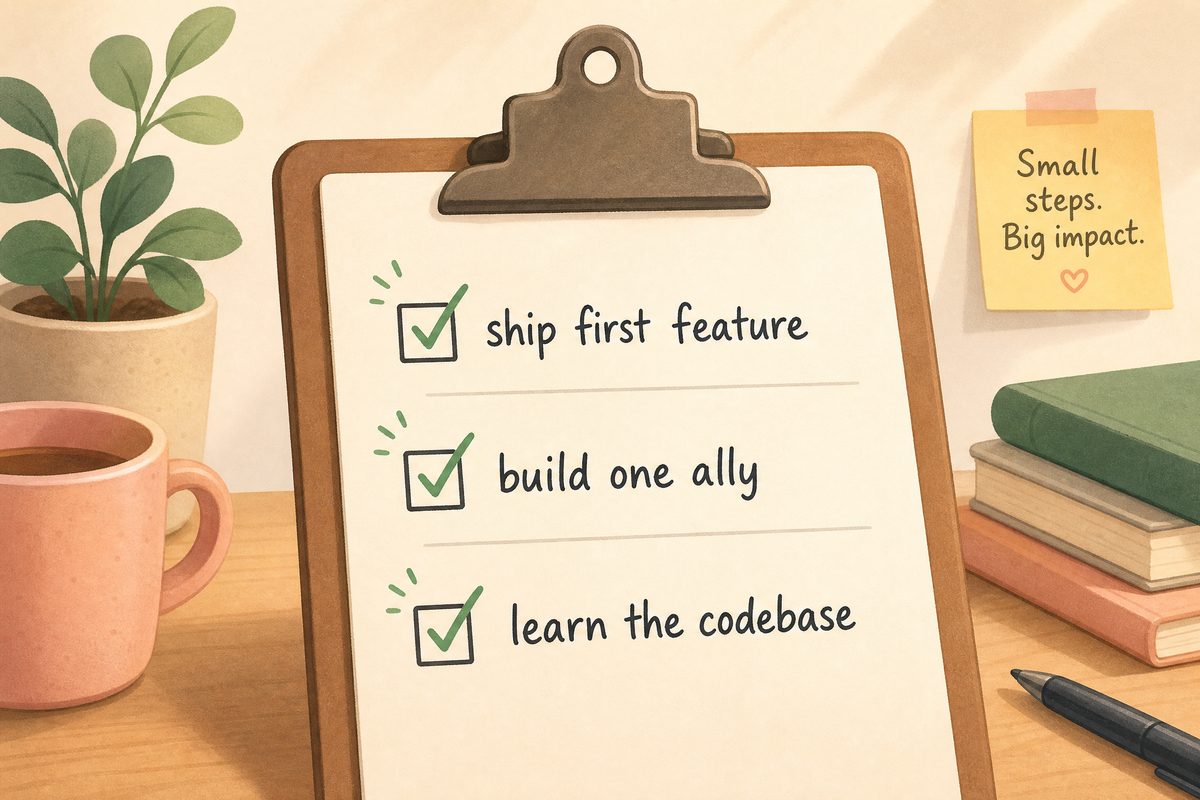
Probation Survival Checklist
This is your tactical weekly/monthly checklist. Copy it. Print it. Stick it on a Post-it next to your monitor.
- Week 1 — Get wired and meet people
- Claim accounts: GitHub, CI, staging, Sentry, Amplitude, Notion. Ask for missing access on Day 1.
- Schedule a 30-minute intro with your manager and a 15-minute intro with the CTO — book them yourself.
- Meet 12 people across functions: engineering (3), product (2), design (1), support (2), sales (2), ops (1), CEO or founder (1).
- Find one tiny bug or docs typo to fix and ship it the first week.
- Month 1 — Ship a micro-win and clarify expectations
- Deliver a scoped change that can go to production in <=2 weeks. Preferably something visible to customers or internal users.
- Ask your manager for success criteria: "Sam, what would make you say my first 30 days went well?"
- Start a "probation notes" doc: decisions, open questions, owners, and metrics.
- Request a 30-day feedback meeting and schedule it now.
- Month 2 — Own a milestone and measure impact
- Take ownership of a small feature or metric with clear acceptance criteria and a delivery date.
- Show measurable progress: percent complete, bug counts, response times, conversion lifts — whatever matters to your team.
- Find one process pain point and propose an incremental fix (not a rewrite).
- Offer to pair with a junior engineer or shadow a support call — helpful, visible, and builds trust.
- Month 3 — Summarize and secure your role
- Prepare a one-page probation summary: achievements, metrics, blockers, and a 90–180 day plan.
- Ask for explicit feedback and any remaining concerns. Address them within 48 hours in writing.
- Confirm next steps: permanent hire, extended probation, or offboarding timeline.
- Celebrate the small wins — you earned a drink (or a team pastry).
Concrete check-in templates (use them verbatim)
Say this. Don’t improvise on panic days. Short, factual, slightly proactive — that’s the vibe.
Weekly Slack update (3 lines):
"Weekly update: shipped ticket #123 (metrics: +2% checkout success), blocked on staging access for service B (requesting infra help), asking for clarification on priority for X vs Y. Available for pairing Tue/Thu mornings. — Jordan"
30-day check-in request (DM to manager):
"Hi Sam — happy to be at the 30-day mark. Can we do a 30-minute check-in this week? I'd love to confirm if my priorities (A, B, C) match yours and get feedback on where I should double down. I'm free Wed 10–11am or Thu 2–4pm."
Asking for feedback after a review (email):
"Thanks for the feedback in today’s meeting. To make sure I act on it: I will (1) ship the retry fix by Friday, (2) add a runbook draft by Monday, and (3) update you with progress mid-next-week. Anything you’d add or re-prioritize?"
How to handle the scary "can we chat?"s
Take a deep breath. The phrase "can we chat?" rarely means immediate doom in startups — usually it means alignment time. Show up prepared, calm, and with evidence.
- Before the meeting: prepare a one-page status: what you’ve done, open blockers, and your plan for the next 7–14 days.
- In the meeting: ask "what are your core concerns?" then repeat them back. Clarify expectations and agree on measurable next steps.
- After the meeting: send a short recap with deadlines and ask for a follow-up date. Visibility turns anxiety into deliverables.
Metrics and language managers care about
If you want to look like someone who reduces risk, speak numbers and outcomes. Here are phrases managers respond to:
- "I reduced mean time to recovery from 6 hours to 2.5 hours by adding a health check and alert."
- "This PR moves the funnel metric by +3% in staging; I'll run an A/B test next week."
- "I shipped an internal doc that cut onboarding time for a new engineer from 8 hours to 5 hours."
Swap in your team's KPIs. If you don’t know them, ask. A good manager will tell you; a great one will help you measure it.
Reality check: turnover is real
Don’t ignore the data: according to SHRM, about 23% of new hires leave within the first 6 months. Startups are brutal on onboarding friction — don’t be a statistic because you were invisible or unclear about priorities.
Final pep talk
Your probation period is not an exam you either ace or fail forever. It’s a short, intense sprint where you prove reliability, alignment, and impact. Be visible, ship bite-sized wins, and ask for clarity when things are fuzzy. Managers love predictable, communicative humans more than brilliant loners who disappear for days.
If you want a simple, printable checklist and the Slack templates in a single PDF, I put one together on newjob.tech — go grab it, print it, and stick it to your monitor. You’ve got this. Breathe, ship, repeat.