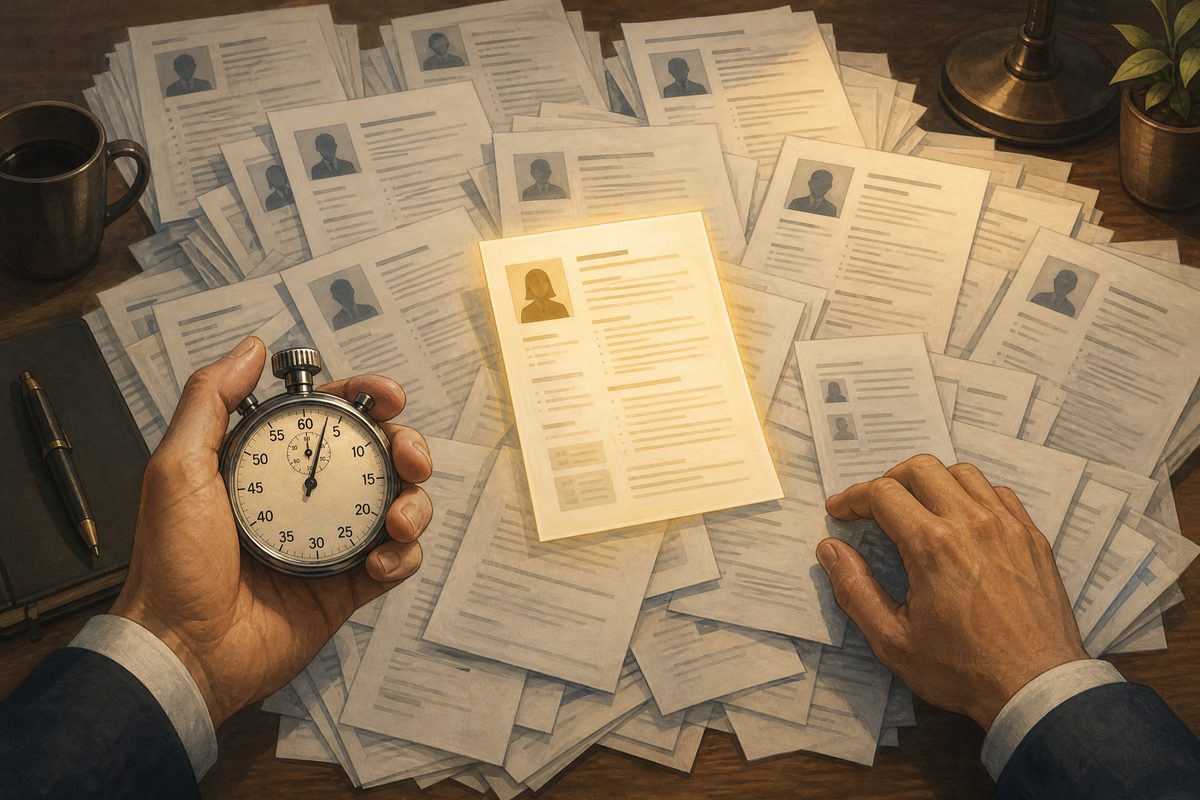
She wasn't reading bullet points. She wasn't marveling at the beautifully designed two-column layout. She was performing a highly optimized pattern-matching exercise.
Eye-tracking studies by The Ladders famously concluded that recruiters spend an average of 6 to 7 seconds on a resume before making an initial "fit or no fit" decision. If you are writing your resume assuming someone is going to read it like a novel, you are optimizing for the wrong audience. You need to optimize for the scan.
The "F-Pattern" Heatmap
When a human opens a document, their eyes naturally follow an F-shaped pattern. They read horizontally across the top, move down a bit, read horizontally again (but shorter), and then scan vertically down the left side.
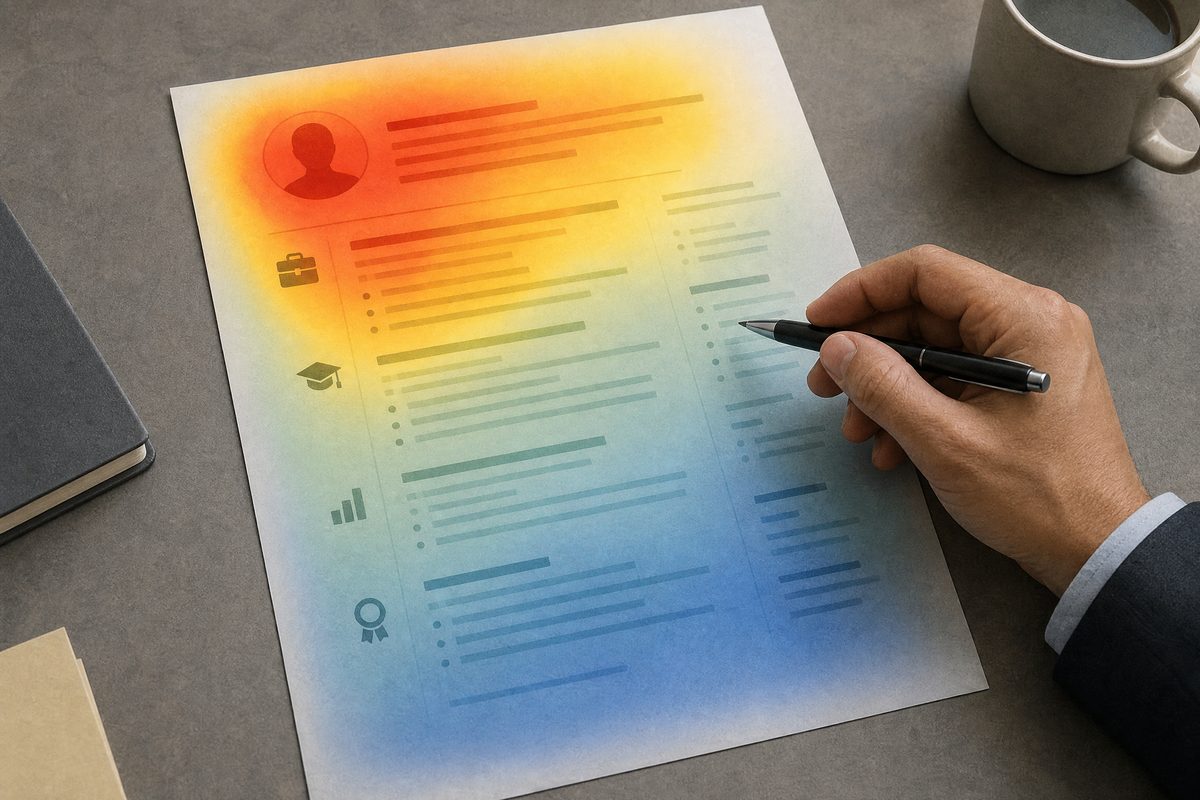
Here is exactly what a recruiter is looking for in those 6 seconds, in order of importance:
Seconds 1-2: The Current Role (Relevance)
Their eyes immediately jump to your most recent job title and company. They are asking one question: "Is this person already doing the job I am hiring for?"
If they are hiring a Product Marketing Manager, and your current title is "Content Writer," you immediately lose points. If your official title doesn't reflect your actual work, change it on your resume. (e.g., If your title is "Marketing Associate III" but you do PMM work, write "Product Marketing Manager" or "Marketing Associate (Product Marketing)").
Seconds 3-4: The Timeline (Tenure and Gaps)
Next, their eyes scan down the right side (or wherever your dates are) to check your tenure. They are looking for job-hopping patterns. If they see 8 months, 11 months, and 9 months at your last three roles, you are likely going into the reject pile unless you have a spectacular referral.
If you have a gap, they will notice it immediately. (This is why formatting dates cleanly and consistently is crucial—don't make them do math).
Seconds 5-6: The Previous Role (Trajectory)
Finally, they look at your previous job title to establish a trajectory. Did you get promoted? Did you move from a no-name company to a recognizable brand? They are trying to establish a narrative of upward momentum.
How to Survive the Scan
If you survive those 6 seconds, the recruiter will go back and actually read your bullet points. To ensure you survive the initial scan, you must ruthlessly format your resume for scannability.
1. Kill the Objective Statement.
Nobody cares that you are a "highly motivated professional seeking a challenging role." It takes up the most valuable real estate on your resume (the top). Replace it with a hard-hitting summary of your specific expertise, or delete it entirely and move your experience up.
2. Use a Single-Column Layout.
Two-column resumes break the natural F-pattern scanning behavior. They confuse human eyes and they absolutely destroy Applicant Tracking Systems (ATS) parsers. Keep it simple: top-to-bottom, single column.
3. Bold the Metrics, Not the Verbs.
When a recruiter finally reads your bullets, their eyes will bounce between bolded text. Don't bold words like Managed or Led. Bold the impact.
"Led a team of 4 engineers to rebuild the checkout flow, resulting in a 24% increase in conversion and $1.2M in new ARR."
Your resume is not a comprehensive historical record of everything you have ever done. It is a marketing document designed to do exactly one thing: survive a 6-second scan so you can get a 30-minute phone call.