

Why most Series A/B startups don't have formal reviews (and why that's not your problem)
Early-stage startups are messy. Founders prioritize product-market fit, investors pressure go-to-market, and HR often doesn't exist until headcount hits 50. Reviews sit at the bottom of the list right after "write onboarding docs" and "fix the production bug that's killing the demo."
I've worked at a Series A with three people in Ops and no HR lead; we reorganized roles twice in six months. That chaos makes standardized reviews rare, inconsistent, or purely ad hoc—so you won't find a polished rubric, ratings committee, or comp bands unless someone builds them.
Here's the kicker: that lack of process gives you leverage. When no one owns the review, you can own it. You get to set the narrative, pick the metrics, and frame the ask instead of reacting to a perf form someone else filled out at 4 a.m.
Why the chaos is actually power (read: opportunity)
In big companies, pay moves in pre-set increments and HR controls the script. In startups, decisions are faster and often made by a founder or two. That means one meeting can change your title, comp, and scope—if you come prepared.
I've seen a friend at a Series B (we'll call him Marcus) send one 2-page doc and get a promotion plus a 15% raise within 10 days. Why? He quantified impact and asked clearly. When the process is loose, clarity wins.
The Self-Review Document strategy (make the review happen yourself)
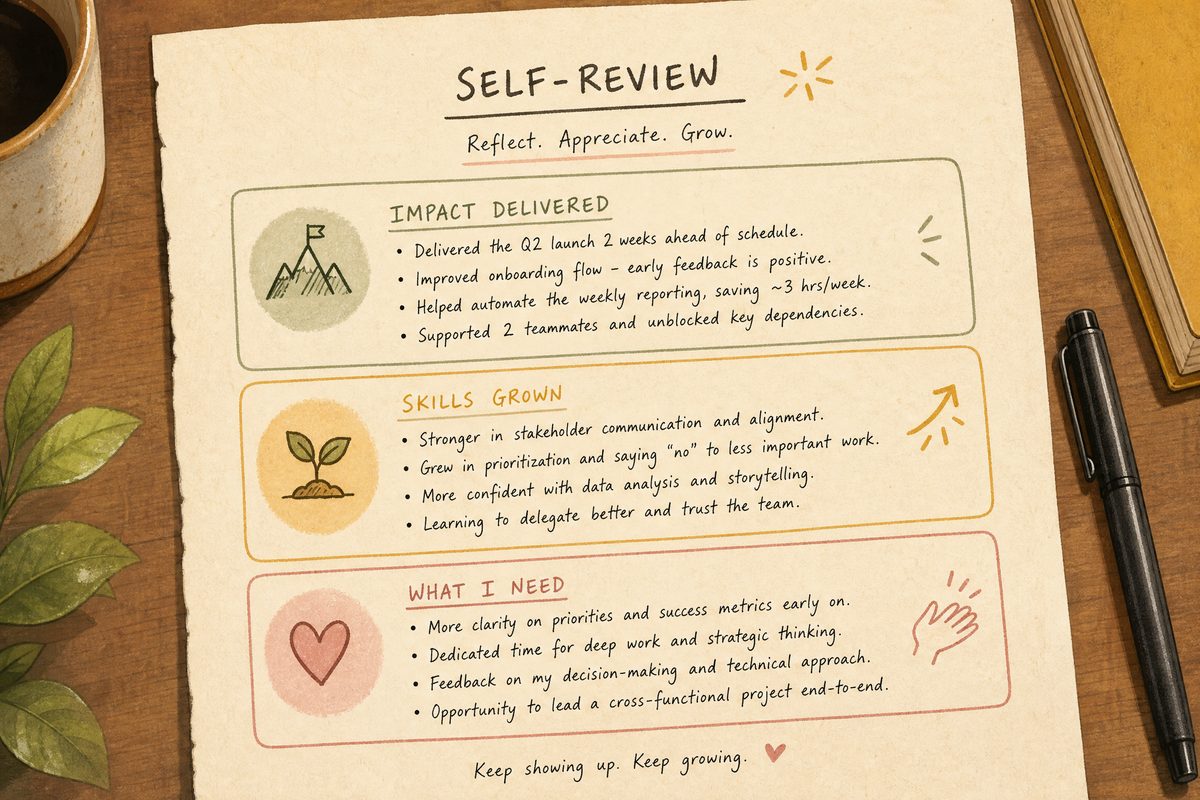
Before you walk into a 30-minute slot squeezed between calls, write your own review. I call this the Self-Review Document. One page, written like you were briefing the CEO. It forces clarity, reduces ambiguity, and makes it easy for your manager to say yes.
Do this at least 48 hours before the meeting and share it in the calendar invite. It signals seriousness and gives your manager time to prepare, which is gold when their calendar is jammed.
Self-Review template (copy-paste this)
Keep it to one page if possible. Use short bullets and numbers. Here's a practical template—drop your specifics in the brackets.
- Header: Name, role, manager, review period (e.g., Jan 2024–Apr 2025)
- Impact (with metrics) — List 3–5 outcomes. For each, include the metric, baseline, result, and business impact. Example: "Increased MRR from $42k to $60k (+43%) in Q1 by launching pricing experiments; ARR impact: +$216k/year."
- Top Wins (2): One-line wins with context. Example: "Closed partnership with Acme Corp—adds $8k ARR monthly and introduced 3 pilot users."
- Growth Areas (2–3): Where you want to grow, not just weaknesses. Example: "Scaling cross-functional leadership; want to own roadmap planning for Y product."
- What I Need (clear ask) — Title, compensation, scope. Example: "Title: Senior Product Manager. Comp: +15% base, targeted total comp $170k (base $135k + equity). Scope: Lead Platform OKR and manage 2 direct reports."
- Risks / Dependencies: Anything blocking your impact—headcount, tooling, approvals.
- Suggested next steps: 30/60/90 plan briefly (what you'll do if approved).
The Brag Document: your single most underrated tool
Don't wait until review week to remember you shipped that migration that saved ops 10 hours/week. Keep a running "Brag Document"—a living Notion or Google Doc with dated entries of wins, customer quotes, metrics, and blockers solved.
One line per win is enough. Example entries: "2024-02-12 — Removed manual billing task (12hrs/week) — saved $7k/month in ops cost"; "2024-06-02 — NPS pilot -> +18 pts vs baseline; expanded to 3 accounts."
Share the brag doc selectively—never broadcast it company-wide. Use it as your evidence bank during the review and when negotiating offers.
How to bring up compensation without making it weird
Money talk feels awkward because most people treat it like a social taboo. Don't. Treat it like a business negotiation. Be specific, calm, and fact-based. Here are scripts that work.
- To schedule the review (email/Slack):
"Hi [Manager], I'd like to schedule a 30–45 minute review to align on impact, expectations, and compensation. I’ll share a 1-page self-review 48 hours before. Does next Tuesday or Thursday work?" - Opening the review (in-meeting):
"Thanks for the time. I shared a one-pager—I'll walk through impact and then ask for your feedback. After that I'd like to discuss title/comp and a 90-day plan if we align." - Direct comp ask (script):
"Based on the results listed—especially the $216k ARR impact and the two accounts we expanded—I’m asking to move to Senior PM with a 12–18% base increase to $135k and an equity refresh to reflect the scope. Is that reasonable from your perspective?" - If they dodge or say 'need to check':
"Totally get it. Can you share the decision owner and timeline? If helpful, I can outline three compensation scenarios (target, stretch, interim) to make approval easier."
The timing hack: when to schedule your review around fundraising
Timing matters. The best window is 30–60 days after a successful fundraising close.Why? There's often fresh budget and founders are optimistic about growth. Equity refreshes, hiring approvals, and comp bands get revisited around that time.
If the round hasn't closed, be cautious. Asking right before a rumored raise can backfire because leadership is focused on closing. If you suspect a round is coming, ask for a quick alignment and schedule the formal review for 30–45 days after the announcement.
Concrete rule: if your company just announced Series A/B, schedule your review for 4–8 weeks later. If a bridge or restructuring is happening, delay until things stabilize. I asked for a raise two days before a messy down-round and you can guess how that went—don't repeat my mistake.
Common mistakes people make (and how to avoid them)
- Being too humble: "I just did my best" won't cut it. Results matter. Present them.
- No data: Vague statements like "improved engagement" are useless. Bring numbers—sessions, revenue, churn, time saved.
- Comparing to peers: "Alice earns more" is a poison argument. Focus on your impact and market rates instead.
- Threatening to quit too early: Ultimatums before you know the answer burn relationships. Save leverage for later if needed.
- Overloading the meeting: If you have a 30-minute slot, share the doc ahead and hit the highlights—don’t read the whole thing verbatim.
Phrases to use (and phrases to avoid)
Language shapes the outcome. Use firm, collaborative phrases. Avoid passive or emotional ones.
- Use: "Based on X results, I'm proposing Y"; "Can we align on a decision owner and timeline?"; "If approved, my 90-day plan is..."
- Avoid: "I feel like...", "I deserve...", "Everyone knows that...", "If you don't... I'll..."
- Nice framing for equity asks: "I'd like an equity refresh to reflect the additional scope; happy to discuss vesting cadence that works for the company."
- When they ask for justification: "Here's the impact, here's the market data, and here's how I plan to scale it. What objections do you see?"
"Only 14% of employees strongly agree their reviews inspire improvement." — Gallup
That stat stings because it shows most reviews are checkbox exercises. If you own the narrative with a Self-Review and Brag Document, you jump from that 14% misery into the small group that actually gets meaningful outcomes.
Post-review follow-up: turn suggestion into action
After the meeting, send a one-paragraph recap within 24 hours. Outline agreed actions, owners, and timelines. Example:
- "Thanks for today. Agreed: 1) I'll move to Senior PM pending comp approval by CFO; 2) [Manager] will present to [Founder] by Friday; 3) Decision timeline: two weeks. My 30/60/90 is attached."
This paper trail forces movement. If the company stalls, use the timeline to follow up weekly and escalate politely to the decision owner you identified during the review.
Final rules of thumb (practical and slightly ruthless)
- Prepare the Self-Review at least 48 hours before the meeting and share it in the invite.
- Keep your Brag Document updated weekly—5 minutes after wins saves hours later.
- Ask for specific outcomes and timelines. Vague promises mean nothing.
- If the company can't meet comp but values you, negotiate title, scope, or a written roadmap to compensation within 90 days.
- If they ghost your follow-ups repeatedly, treat it as data about how they value you and plan accordingly.
Startups are rough terrain, but lacking process is an advantage if you act like you belong in the room. Own the review, quantify your impact, and make a clear, reasonable ask. I promise: the person who shows up with a crisp one-pager gets listened to far more often than the one who hopes their work will speak for itself.
Ready to make that next move? If you’re thinking about new roles where your impact is clearer and your compensation reflects it, check out newjob.tech — they list curated startup roles and help you position your story the way I described above.